Pearson Edexcel · GCSE · Computer Science
Course version: 1CP2 · Version from Sept 2020
Understand the importance of network security, ways of identifying network…
Full specification wording
Network security: 4.2.1 understand the importance of network security, ways of identifying network vulnerabilities (penetration testing, ethical hacking) and methods of protecting networks (access control, physical security, firewalls)
Network security matters because a network carries valuable data and shared services, so a single weakness can expose many users at once.
Checked against the Pearson Edexcel 1CP2 specification (opens in a new tab) on .
- 4 key terms
Study notes
From the checked teaching notes for this specification point.
The idea
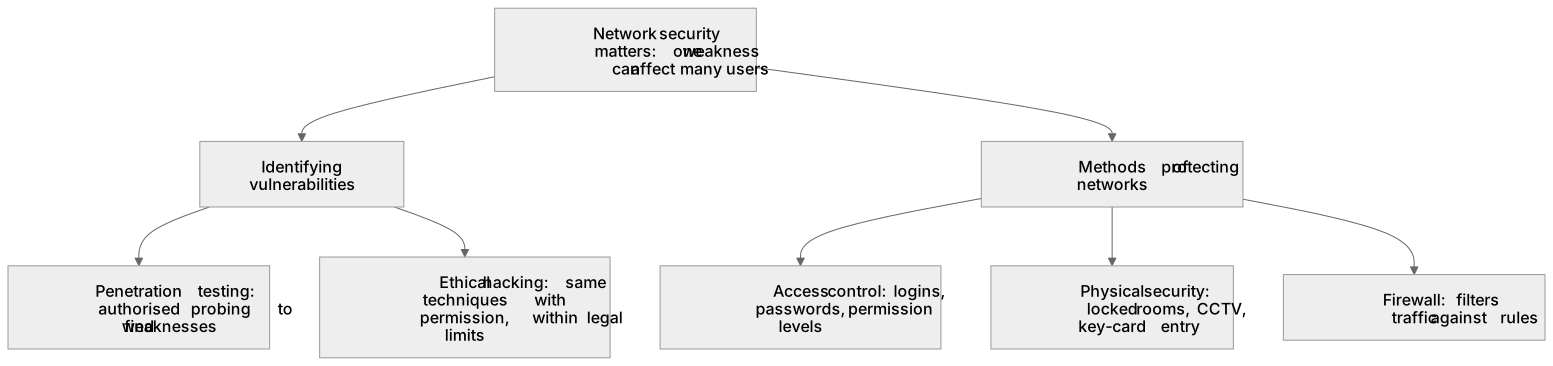
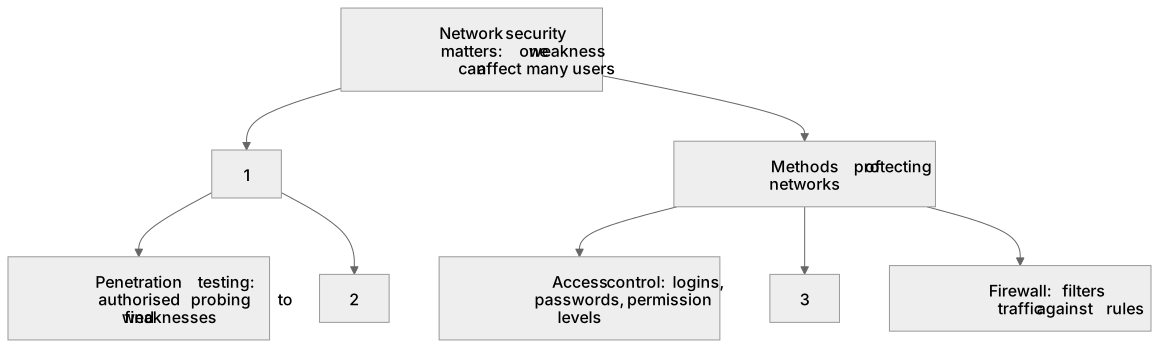
Network security matters because a network carries valuable data and shared services, so a single weakness can expose many users at once. Learners should be able to explain why protection is important, for example a school network holding pupil records, and then match each threat to a suitable defence. Vulnerabilities are identified by penetration testing, where an authorised tester probes a system with the owner's permission to find weaknesses before criminals do, and by ethical hacking, which uses the same techniques under a legal agreement. Protection methods include access control, such as usernames, strong passwords and permission levels that limit what each user can open; physical security, such as locked server rooms, CCTV and key-card entry, which stops direct tampering or theft; and firewalls, which filter incoming and outgoing traffic against rules.
What earns the marks
- Network security protects data, hardware and services shared across a network, so one weakness can affect many users.
- Penetration testing is authorised probing of a system to find vulnerabilities before attackers exploit them.
- Ethical hacking uses the same techniques as malicious hacking but with permission and within legal and contractual limits.
- Access control restricts who may use a system or which resources they may open, using logins, passwords and permission levels.
- Physical security protects equipment directly, for example locked rooms, CCTV and key-card entry to server areas.
- A firewall filters network traffic against a set of rules to block unwanted or suspicious connections.
Common mistakes and how to put them right
Thinking ethical hacking is the same as criminal hacking.
Put it right: Ethical hacking is authorised, agreed in advance and bounded by law and contract.
Believing a firewall stops all malware.
Put it right: A firewall filters traffic by rules and cannot remove malware already installed or opened by a user.
Confusing access control with physical security.
Put it right: Access control governs logical use of accounts and resources, while physical security protects the equipment itself.
Exam tips
- Underline the key noun in the question, such as firewall, access control or penetration testing, before reading the options.
- Eliminate options that describe a different category of protection from the one named in the question.
- Check whether the question asks why security matters or how a method works, because the correct option must match that purpose.
Try the lesson
The start of the Network security: 4.2.1 understand the importance of network security, ways of identifying network vulnerabilities (penetration testing, ethical hacking) and methods of protecting networks (access control, physical security, firewalls) lesson, made from checked teaching notes for this specification point.
Have a go first
A company gives a tester written permission to attempt to break into its network, so that weaknesses can be found and fixed before criminals exploit them. What is this process called?
Listen
Network security matters because a network carries valuable data and shared services, so a single weakness can expose many users at once. Learners should be able to explain why protection is important, for example a school network holding pupil records, and then match each threat to a suitable defence. Vulnerabilities are identified by penetration testing, where an authorised tester probes a system with the owner's permission to find weaknesses before criminals do, and by ethical hacking, which uses the same techniques under a legal agreement. Protection methods include access control, such as usernames, strong passwords and permission levels that limit what each user can open; physical security, such as locked server rooms, CCTV and key-card entry, which stops direct tampering or theft; and firewalls, which filter incoming and outgoing traffic against rules. A strong answer earns marks for these points. Network security protects data, hardware and services shared across a network, so one weakness can affect many users. Penetration testing is authorised probing of a system to find vulnerabilities before attackers exploit them. Ethical hacking uses the same techniques as malicious hacking but with permission and within legal and contractual limits. Access control restricts who may use a system or which resources they may open, using logins, passwords and permission levels. A common slip: Thinking ethical hacking is the same as criminal hacking. Instead, ethical hacking is authorised, agreed in advance and bounded by law and contract. Exam tip: Underline the key noun in the question, such as firewall, access control or penetration testing, before reading the options.
See it
Key words
Say what each word means before you turn the card.
Penetration testing
Try answering aloud or in your head before turning the card.
Ethical hacking
Try answering aloud or in your head before turning the card.
Access control
Try answering aloud or in your head before turning the card.
Firewall
Try answering aloud or in your head before turning the card.
See every definition
- Penetration testing
- Authorised probing of a system to find vulnerabilities before attackers exploit them.
- Ethical hacking
- Uses the same techniques as malicious hacking but with permission and within legal and contractual limits.
- Access control
- Restricts who may use a system or which resources they may open, using logins, passwords and permission levels.
- Firewall
- Filters network traffic against a set of rules to block unwanted or suspicious connections.
Label the diagram
Some boxes have lost their names. Pick the right name for each number.
1Box 1
2Box 2
3Box 3
There is more to this lesson
The full lesson goes on to check your understanding and help you earn the marks. Create a free account to carry on, with your progress saved.
A week of Premium from your first lesson · Then the free plan continues · No card, no charge
Test your understanding of Network security: 4.2.1 understand the importance of network security, ways of identifying network vulnerabilities (penetration testing, ethical hacking) and methods of protecting networks (access control, physical security, firewalls)
Active recall beats re-reading. Take an instant quiz now to test what you’ve learned and lock it into long-term memory.
A week of Premium from your first lesson · Then the free plan continues · No card, no charge